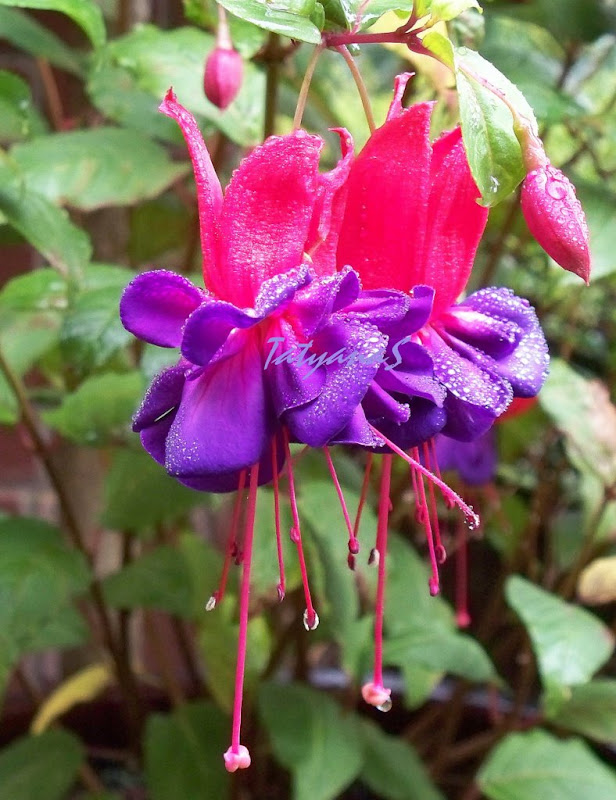
I looked at him for 4 seasons. I smelled him, I touched him, I admired him. I showed him to my girlfriends and they got jealous. I was amazed by his reproductive abilities. I did nothing special for him, but he returned every summer to my garden, and not alone - with hundreds friends. I didn't know his name (see previous post). I know now, thanks to fellow blotanists. Karrita, Cameron, Tina helped me in my search for his identity.
Silene armeria. Thanks, Blotanical!
I love this plant. Some web sites call it invasive. It doesn't bother me that it self-seeds, since my perennial bed is pretty big. If I don't like it in certain place - it is very easy to remove. I like that it appears in large groups. It creats waves of bright pink spots.
Other names: None-so-Pretty, Catchfly.
Height: Up to 2 ft.
Flower Color: Brilliant magenta, pink.
Plant Type: Annual. Grows quickly, blooms heavily. Regrows next spring if seeds fall on bare ground.
It feels good to find an answer. And it is somehow ... sad. I enjoyed looking through the books, web sites, comparing pictures, guessing. I found an answer and lost a mystery. I think I need to find another one. This time it could be in my garage. Another stranger. I knew its name, but forgot it. It's huge and very particular. I killed it once, but it survived. Well, it is a different story.
******************************************************************************
From Wikipedia:
Silene armeria, commonly known as the Sweet William Catchfly, is a plant of the family
Caryophyllaceae. Originally a native of Europe, it has become widespread in the USA. A small-growing
form is known as Dwarf Catchfly. The name comes from the way in which small insects are trapped by the sticky sap exuded onto the stem. However it is not currently regarded as a
carnivorous plant, though it has been identified as a carnivorous plant in the past.
[1]References
Williams, Amy. (1913).
Carnivorous plants of Ohio. The Ohio Naturalist, 13(5): 97-99.