Pictures can be enlarged by clicking on them
*
If you ask me what plant pleases me year around and never, even in winter, fails me, I 'd name Euphorbia (other name - Spurge). Taking in consideration that there are thousands species in the family Euphorbiaceae, I need to be more specific. There are three varieties that I have in my garden: Euphorbia characias ssp. wulfenii 'John Tomlinson', Euphorbia x martinii (variety's name is unknown to me) and Euphorbia amygdaloides 'Ruby Glow'.
____________________________________________________
Among them, my favorite is the Euphorbia characias ssp. wulfenii 'John Tomlinson'. Its tag tells that it originated from wild-collected Yugoslavian seeds. My main plant, a mother ship of all other euphorbias, is about 6 years old, grows in a location with morning sun and survives winters colder than zero degrees F.
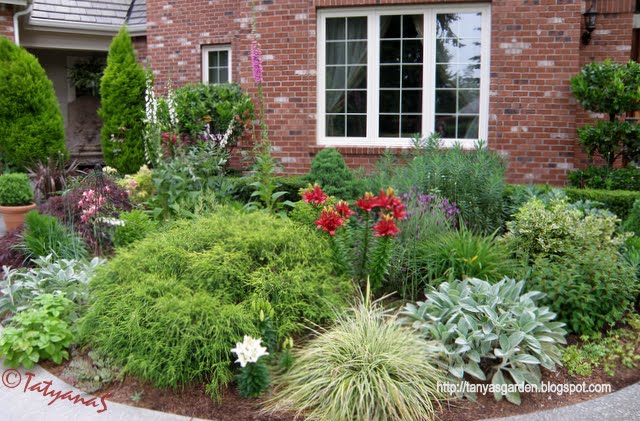
This specimen is one of the central plants in my front flowerbed (under the right side of the window).
*
It's huge in size and grows taller than in this picture. They recommend to cut old stems to base after flowering. This is what I do. Since there are always lots of stems without blooms, the plant looks full even after the cutting (as in the pictures above and below).
*

*
If you ask me what plant pleases me year around and never, even in winter, fails me, I 'd name Euphorbia (other name - Spurge). Taking in consideration that there are thousands species in the family Euphorbiaceae, I need to be more specific. There are three varieties that I have in my garden: Euphorbia characias ssp. wulfenii 'John Tomlinson', Euphorbia x martinii (variety's name is unknown to me) and Euphorbia amygdaloides 'Ruby Glow'.
____________________________________________________
Among them, my favorite is the Euphorbia characias ssp. wulfenii 'John Tomlinson'. Its tag tells that it originated from wild-collected Yugoslavian seeds. My main plant, a mother ship of all other euphorbias, is about 6 years old, grows in a location with morning sun and survives winters colder than zero degrees F.
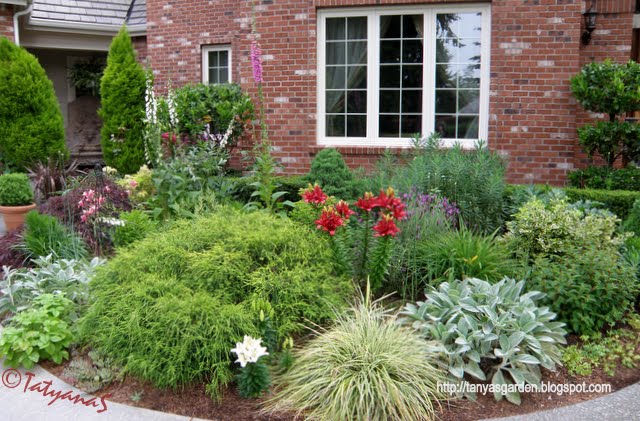
This specimen is one of the central plants in my front flowerbed (under the right side of the window).
*
It's huge in size and grows taller than in this picture. They recommend to cut old stems to base after flowering. This is what I do. Since there are always lots of stems without blooms, the plant looks full even after the cutting (as in the pictures above and below).
*

*

*
Euphorbia might be grown mainly for its foliage, but it looks even more interesting when in bloom. Its large flowers (to be correct - cyathia) have a wonderful chartreuse color:
.

*
They appear in the spring, long before other plants start blooming, and last for several months.
.

*

Euphorbia's blooms are joined by Spanish lavender
*
.

*
They appear in the spring, long before other plants start blooming, and last for several months.
.

*

Euphorbia's blooms are joined by Spanish lavender
*

Euphorbia in bloom with the tree peony' buds seen on the left and tulips in the container
*
Euphorbia is a very essential part of my front flowerbed
.

Euphorbia's blooms glowing in the morning sun with tree peony flowers
*

*
With or without other blooms, Euphorbia adds height, color and texture to my garden:
.

Euphorbia is blooming behind lavender, asiatic lilies and daylilies
After several years of growing in front of the house, my Euphorbia started to spread its seeds here and there. It led to new plants popping up all around. I keep those which are in the 'right' place and replant those which are growing too close to other plants.
*

Two new euphorbia plants in the so called Accidental bed, on both sides of the urn*

Two new euphorbia plants in the so called Accidental bed, on both sides of the urn*
The plants are drought resistant and grow even in spaces without a sprinkler system.
In the fall, my Euphorbia looks as good as in the spring and summer. In the picture below, you can see it behind the yellow Japanese maple.
*

*

*
Winter comes, and it still stands strong. When the temperatures fall below freezing, its leaves look almost dead, but after the temperature warms up, they are back to normal.
This is how it looks now, in December:
.

This picture of Euphorbia characias ssp. wulfenii 'John Tomlinson'

This picture of Euphorbia characias ssp. wulfenii 'John Tomlinson'
was taken on the 17th of December, 2010.
*

Here, the blooms do look brown.

*
*
New plants are so abundant that I started to add them to my containers.
Some characteristics:
Some characteristics:
Exposure: Full sun
Average size: 32 inches (80 cm) tall, 24 inches (60 cm) wide
Water Use: Low once established
Cold Hardiness: 0 to - 10 F (-18 to -23 C)
Blooms: February - June
__________________________________________________
Unlike 'John Tomlinson', the second plant came from a hardware store with the less specific name Euphorbia x martinii (E. amygdaloides x E. characias; 'martinii' comes from Martin, the name of the plant's creator).
Shorter and more compact, it has leaves which change in color from green to pinkish, to dark red and finally to brown.
Shorter and more compact, it has leaves which change in color from green to pinkish, to dark red and finally to brown.
.

Euphorbia X martinii rather pinkish blooms are in the middle of the picture

Euphorbia X martinii rather pinkish blooms are in the middle of the picture
together with blooming daisies, astilbe and alliums.
*
*

Here, the blooms do look brown.
Foxglove and lavender blooms are seen too
*

*
This plant blooms when 'John Tomlinson' is already done blooming.
In the next picture, it is joined by acanthus,aliums,
fuchsia and long-blooming lavender:
.

*
*

*
Blooming Euphorbia in one of the tour's gardens is seen in the middle of the picture below:
.

*

Click on the pictures to enlarge them
In the next picture, it is joined by acanthus,aliums,
fuchsia and long-blooming lavender:
.

*
This particular plant hasn't surprised me with any baby plants.
Some characteristics
Exposure: Sun
Exposure: Sun
Average size: 2-3 feet (60-90 cm) tall, 2-3 feet (60-90 cm) wide
Water Use: Low once established
Cold hardiness: 0 to -10 F (-18 to -23 C)
Blooms: Spring
______________________________________________
The third type Euphorbia amygdaloides 'Ruby Glow' (Wood spurge) was acquired last summer with the hope of bringing color to the dry area where not many other plants survived. Plants are compact with new growth being bright red, darkening to almost black. Stems are red. I was attracted to this plant after reading that it does good in dry, sandy, well-drained soil. It should be comfortable in the very front of our yard where the driveway starts. I like to see them near my Blue fescue (Festuca cineria 'Elijah's Blue').
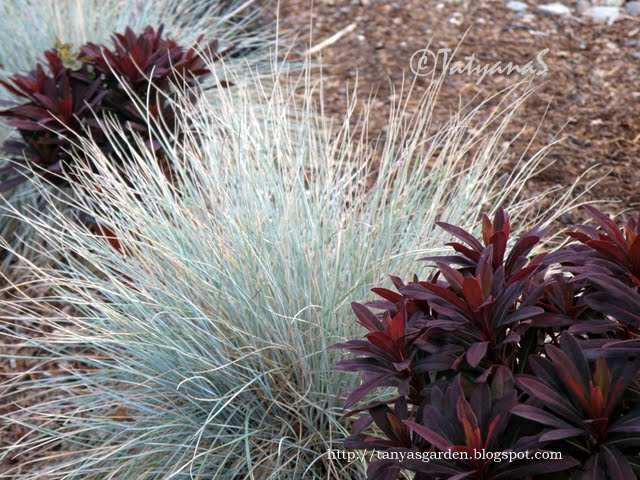
This is how that spot looked before the Euphorbias were planted:
This is how that spot looked before the Euphorbias were planted:
.

*

*
Some characteristics:
Exposure: Full sun (tolerates part shades but full sun gives best foliage color)
Everage size: 10-12 inches (25-30 cm) tall, 18 inches (45 cm) wide
Water Use: Low once established
Cold hardiness: Hardy to -10 F (-23 C)
Cold hardiness: Hardy to -10 F (-23 C)
Blooms: March - May
__________________________
Following are some Euphorbia pictures in other gardens.
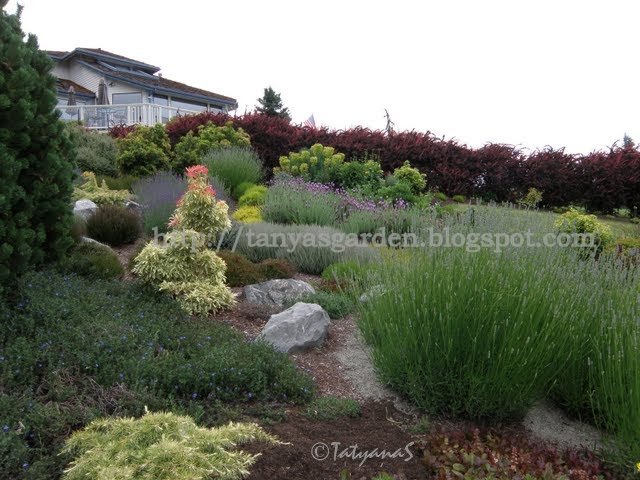
This is how Euphorbia looks in the slope garden which was featured in one of the most readable posts in my blog Slope Garden Extraordinaire :
.
.
*
*

*
Blooming Euphorbia in one of the tour's gardens is seen in the middle of the picture below:
.

*
In the next picture blooming Euphorbia is on the left:
.

Click on the pictures to enlarge them
*
______________________________________
A good article about E. can be found on the Portland Nursery site . Interestingly, prolifically self-seed types of E. are prohibited for sale in Oregon nurseries. Euphorbia oblongata (oblong spurge, eggleaf spurge) is included in the list of the most dangerous invaders to keep out by the Oregon Invasive Species Council. (Curious how it looks? You can see its picture here)
The Portland Nursery site, along with others, stresses an importance of wearing protective gloves when working with Euphorbia because they exude a white sap that is a skin irritant and can be poisonous if ingested.
I never have had any problems working with my plants, but I agree that caution won't hurt.
By the way, the common name 'Spurge' derives from the Middle English/Old French espurge ('to purge'), due to the use of the plant's sap as a purgative.
***
Copyright 2010 TatyanaS
I never have had any problems working with my plants, but I agree that caution won't hurt.
By the way, the common name 'Spurge' derives from the Middle English/Old French espurge ('to purge'), due to the use of the plant's sap as a purgative.
***
Copyright 2010 TatyanaS