MySecretGarden

U.S.A., Washington State. USDA zone 8b. Sunset climate zone 5

Back from AZ & Our Gloria is in WSJ


*
Our blogging friend Gloria Bonde's house and garden are in a picture in today's issue of the Wall Street Journal!
I was sipping coffee in my garden and looking through the WSJ when I saw a familiar name in the article 'Gardening Without a Sprinkler' by Anne Marie Chaker (WSJ, August 18, 2010). The article is about a growing trend of converting lawns to xeriscapes. Several gardens are featured in the article. Their owners use xeric principles such as using native plants, grouping plants with similar watering needs, using mulches, etc. Some gardeners got the ideas from their trips to Tuscany and southern France. Eliminating mowing, fertilizing, weed-control applications, excessive watering, and saving money are the main pluses of "dry gardens". The article also touches upon the issue of the xeric approach contradicting the landscaping standards of some homeowner associations.
*

*
Congratulations, Gloria, on your garden being pictured in one of the most prominent national newspapers! I was excited to see your name!
Gloria's blog, Dakota Garden, is here: http://www.dakotagarden.com/
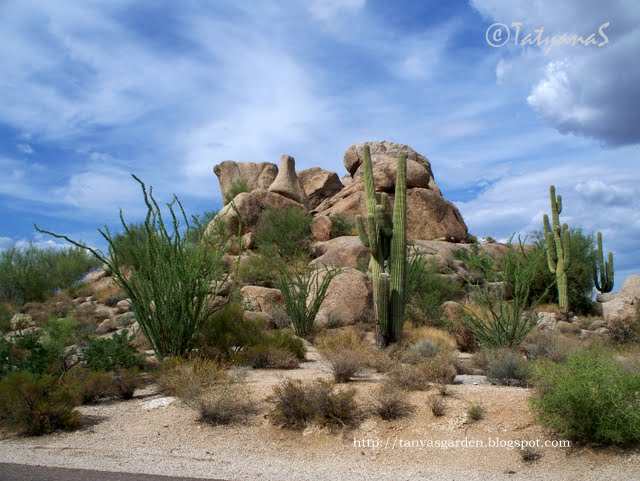
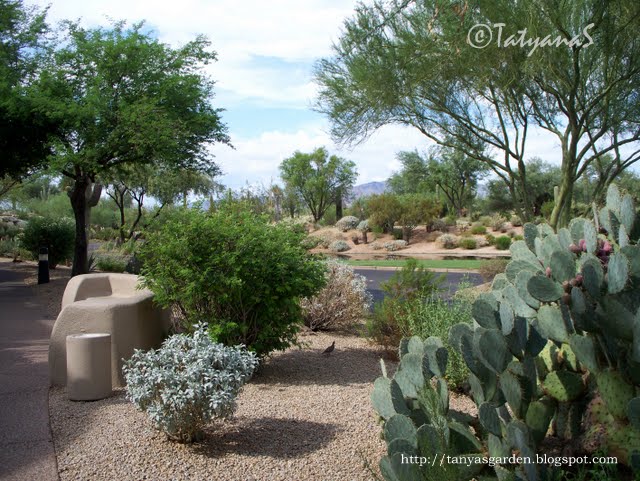
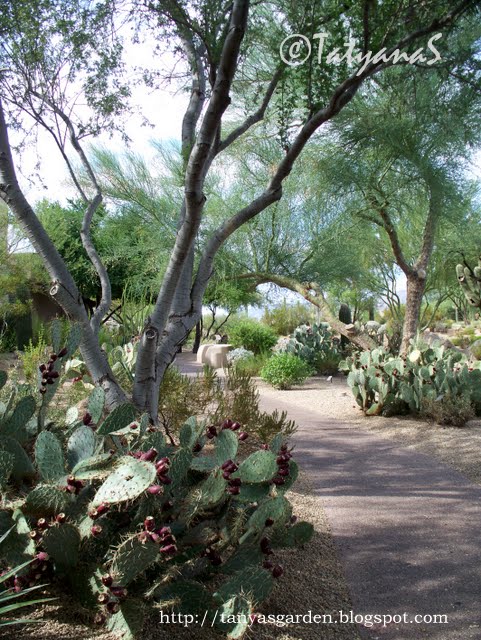
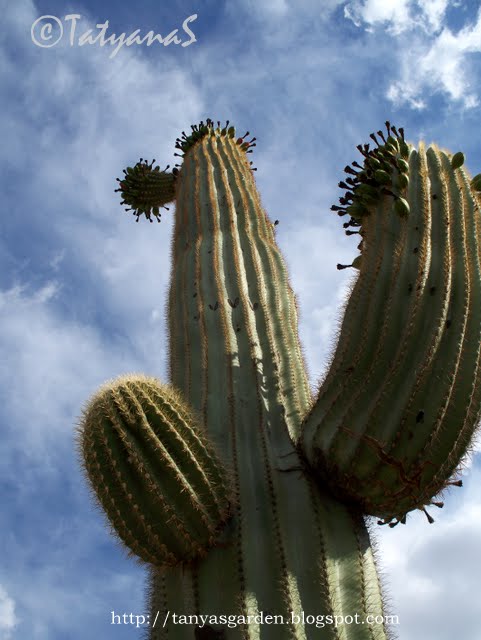
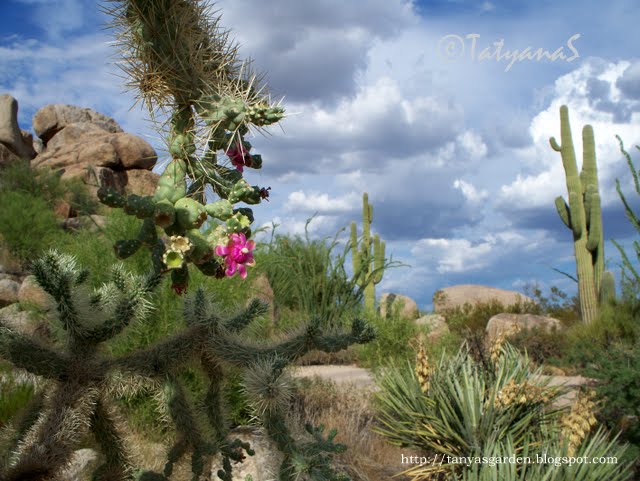
I just came back from Phoenix, Arizona where we celebrated the 90th Birthday of my dear mother-in-law, Mary. The temperatures were 107-111 F (38-40 C), but it didn't stop me from walking around and admiring some of the wonderful desert plants and extraordinary landscapes.
*

*

*

*

*
Copyright 2010 TatyanaS

Containers in My Garden


*
There is a smorgasbord of containers in my garden. They are of different sizes, colors, shapes, materials and pedigrees. Some of them came from rummage sales, some from home improvement stores and several from upscale fountain & statuary places.
I love lush, overflowing, eye-catching plant arrangements in the containers near restaurants, hotels and other places which are created by professional gardeners. I admire them but never actually tried to make even the slightest replicas of those masterieces. I always remember about my containers later, after all the other works in the garden. I also rarely follow the general rule about container arrangements: to combine such categories of plants as thriller, filler and spiller.
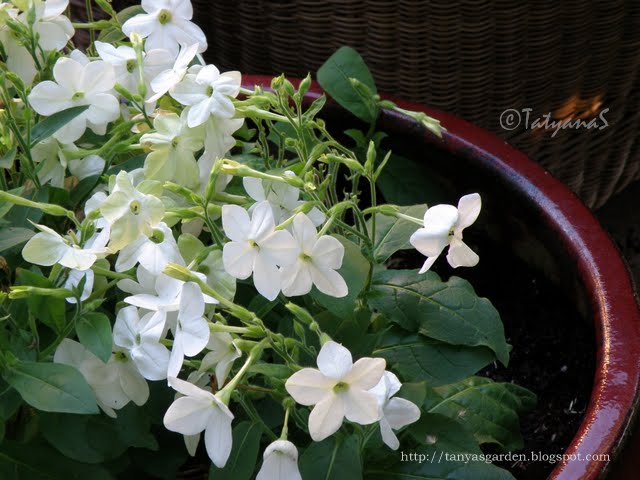
I even noticed that my principles of putting together my outfit and container arrangements are somehow similar. I go for a limited number of elements, sometimes with just several colors involved. Like this nicotiana, for example, in a dark red glazed pot.
.
*
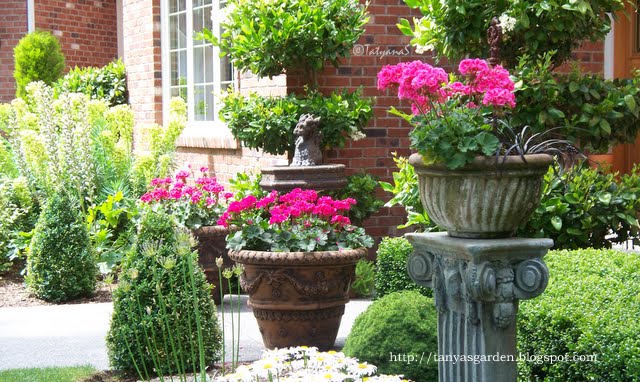
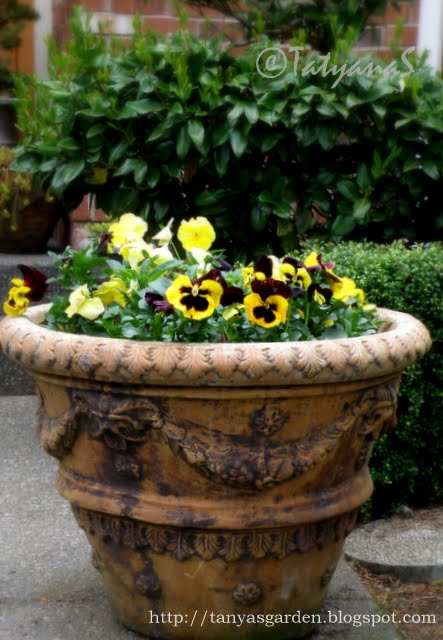
Some containers are so ornate and beautiful that I try to plant them with the plants which won't spill out and hide their beauty. Let's take this pair of stone-cast exquisite pots.
.
.
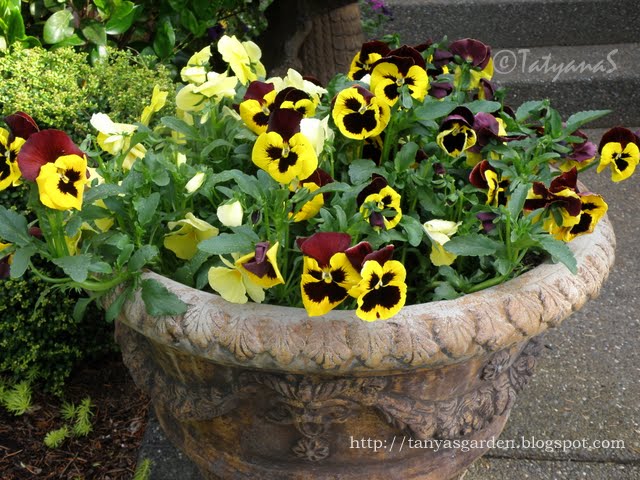
Geranium, pansy and nicotiana were their residents in different seasons.
.
*
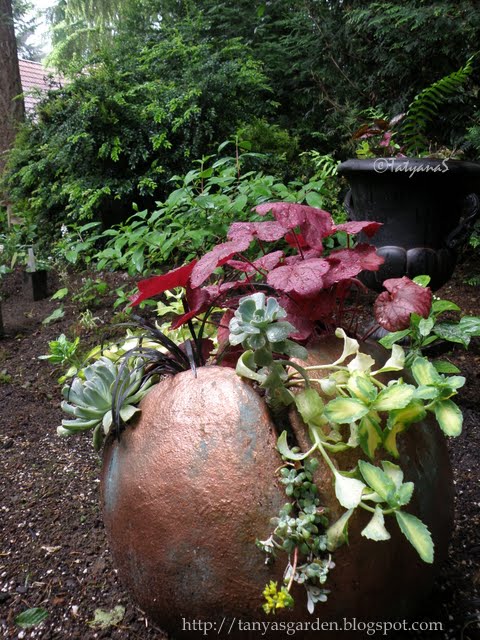
Below is my newest pot. It is very special to me because it was made by Jim, the hosta hybridizer whose breathtaking shade garden was featured here:
'Enchanted Garden Of A Hosta Hybridizer'
.
*
Here it is in Jim's garden:
.

*
It could be used just as a garden ornament, but I planted it as soon as I came home after touring Jim's garden. The plant material was found in the garden: sedum, heuchera, some type of echeveria.
What I like about containers is that you can always replant them, replace some plants or just move them out of your sight if you don't like them, thus waiting for the moment when new ideas strike you.
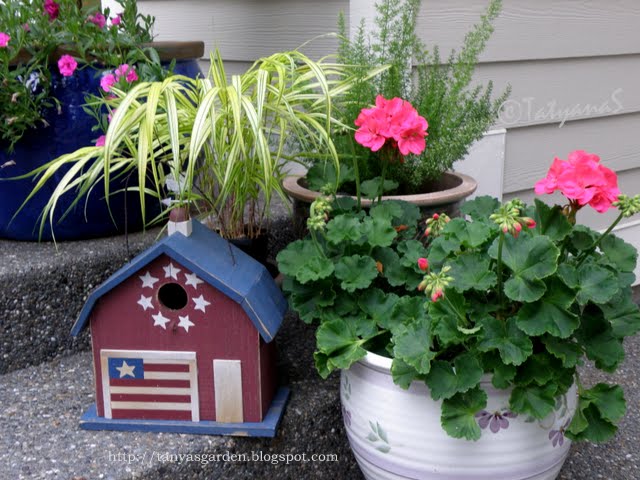
One of my favorite plants for containers is geranium. I overwinter the best and healthiest looking geraniums. First, I used to get the plants from the pots and keep them dry in the garage during the winter. How I revitalized them in spring is told here: 'Geranium Revival'
*
Lately, I stopped doing that. Not all the plants survive, and I don't want to spend time on that. I bring pots in the garage, start watering them at the end of the winter and watch who survived and who didn't. I have Martha Washington geraniums, which are in their 4th season, in the same pots. With zonal geraniums, my success rate is ....let's say 50%.
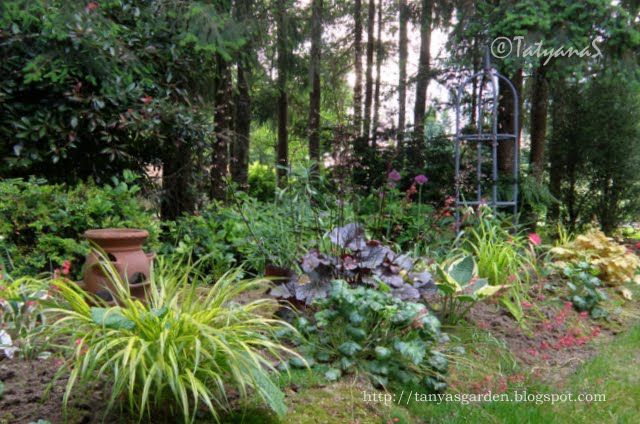
Some containers miss a season or two. The strawberry pot, below, wasn't filled this summer but looks good just as it is.
.
*
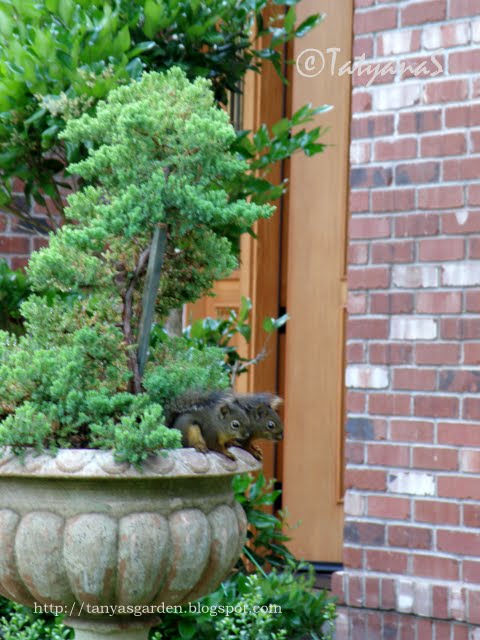
Sometimes, changing a pot makes a huge difference in how a plant looks. Isn't it true about us too? Change an outfit and you are a brand new woman! Several years ago, I was looking for cut flowers to decorate a room. Finding nothing suiting my fancy, I bought a potted evergreen for $10. It stood in the room for quite a long time, then was moved outside and spent two or three years there. Here it is, in the next picture, showing two young squirrels which I flushed out while watering. Squirrels are cute, but the plant looks like nothing special, doesn't it? It was still in its original black plastic pot that I put inside a nice ceramic container (by the way, it got broken later).
.
*
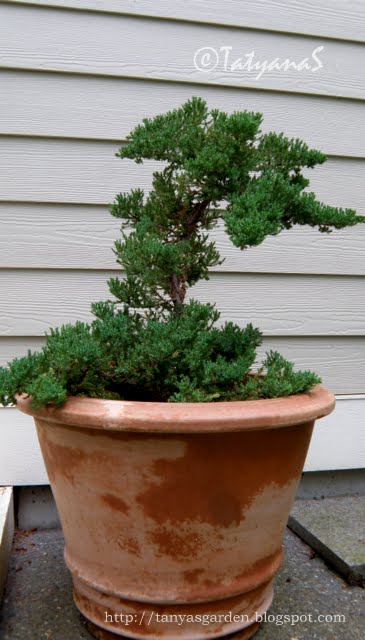
After visiting the Little and Lewis garden this summer, I looked critically at my potted plants, and the above mentioned evergreen caught my attention. I repotted it into the big Italian terracota pot bought for a miserable price several years ago. It looked better. I decided to prop up the supporting stick and the stick broke! How glad I was! The plant looks absolutely gorgeous in its new pot and without that stick! Simple and elegant, don't you think so?
.
*
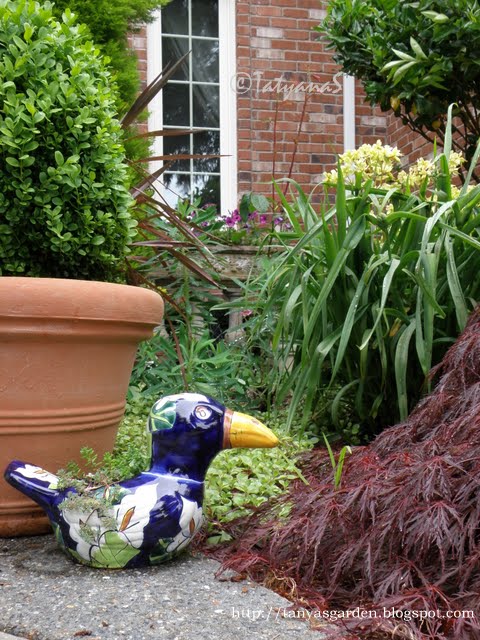
I like small planters too, like this cute Tucan:
.
*
If I can't part with some of the non-gardening items, I use them in the garden as containers:
.

*
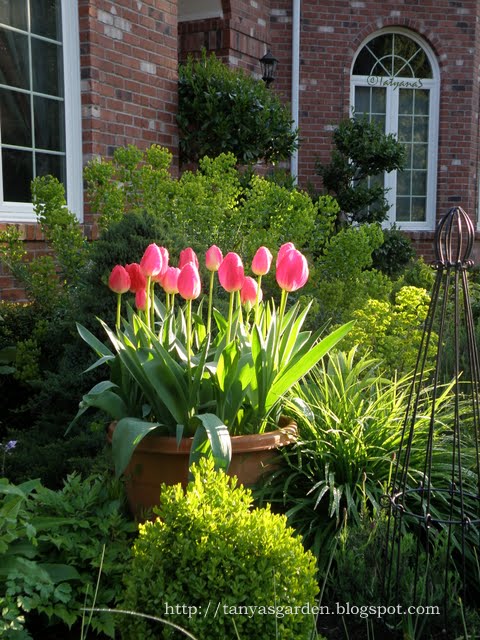
Now, a little follow-up about my tulip containers featured earlier in the season
*
I use simple pots to host tulips. Next year, I hope to find out what happens with tulips if the bulbs are left in the pots for winter. Or, should I get them out and store them in the refrigerator? If I leave them outside, I'll place them under the big fir trees to prevent rottening from rains.
.
*
The question was asked if I planted anything else in them to grow after the tulips wilt. Yes, I threw some parsley seeds there! And, I have some parsley growing!
***
There are more containers in my garden, but I showed you my favorites. Thanks for visiting, and I hope to see your favorite pots one day!


Copyright 2010 TatyanaS

Slope Garden Extraordinaire


*
If life gives you a lemon, make lemonade; if life gives you a slope, turn it into a garden extraordinaire. One of my favorite gardens of the 2010 garden tours was created on the side of a hill overlooking Puget Sound and the Olympic mountains.

*
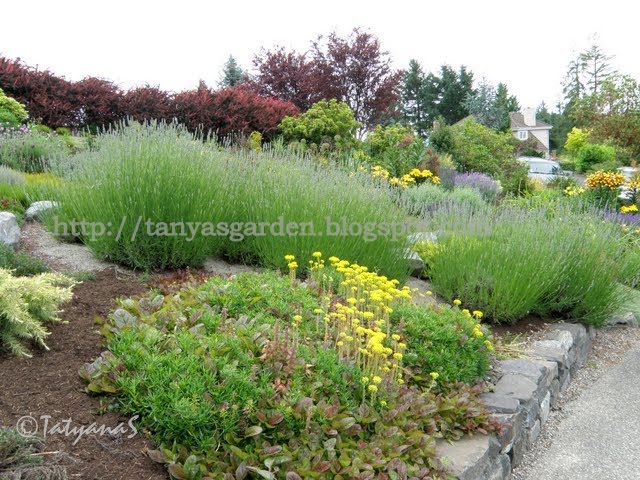
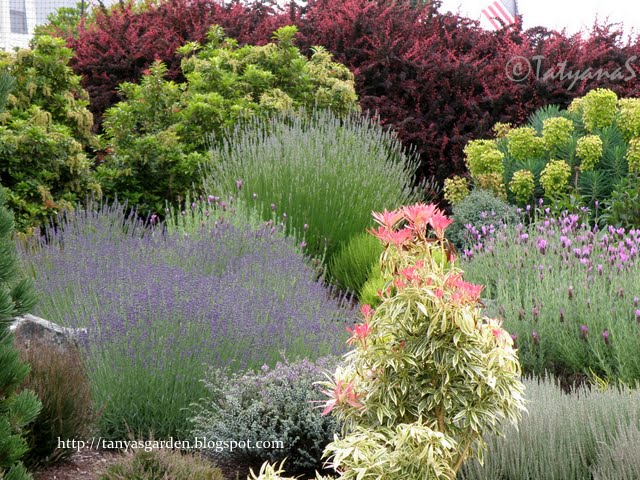
Waves of lavender got my attention right away. Royal velvet, Provence, Spanish...eight types of it. Now, I ask myself why do I have only two types of lavender in my own garden?
*

*
To turn a sloping lawn into a lush, colorful garden, Terri, the garden owner, used a lasagna method with newspapers and mulch. Six years of work and love, and what do they have now? A masterpiece!
*
*

*
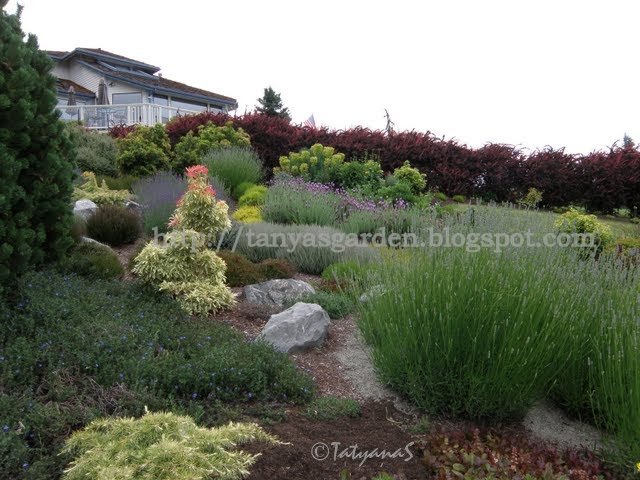
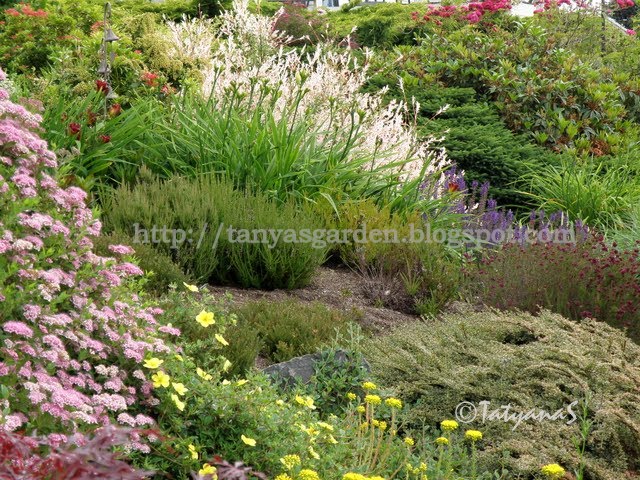
Heath and heather, ornamental grasses and groundcovers join lavender to create a perfect xeric landscape.
Perennials, dwarf conifers and shrubs with interesting foliage add color and texture to the overall picture.
.


*
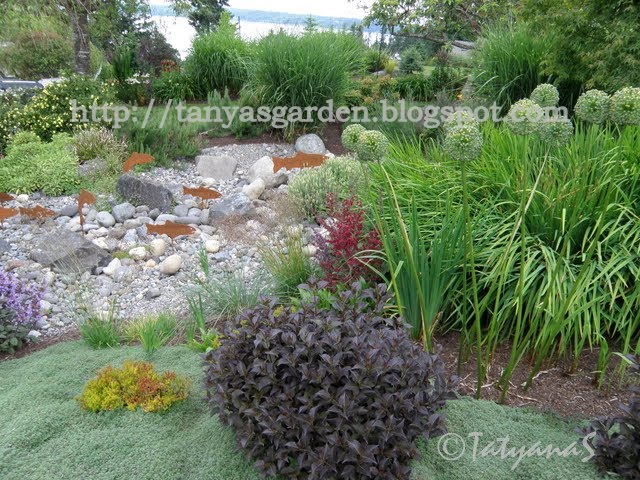
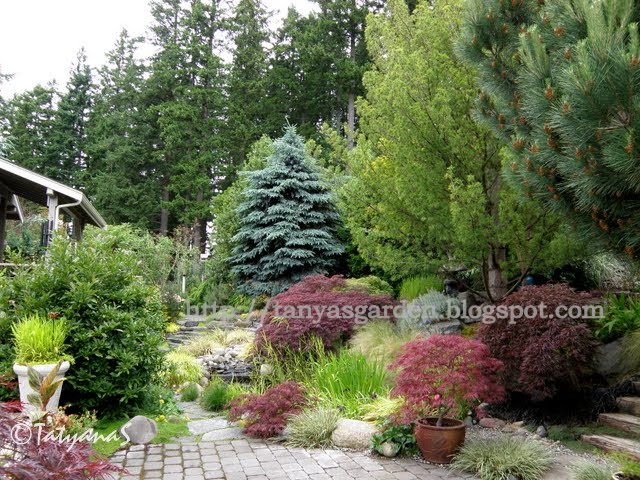
Dry creek with metal salmon (of course, salmon: it's the Northwest!) surrounded by Japanese maples, Mexican feather and other grasses, alliums, etc. was one of my favorite features.
.

*
Isn't it gorgeous or what?
.

*

*

*
The garden has so many points of interest! Wherever I looked at it, it was picture perfect! It even had my favorite foxgloves!
.

*
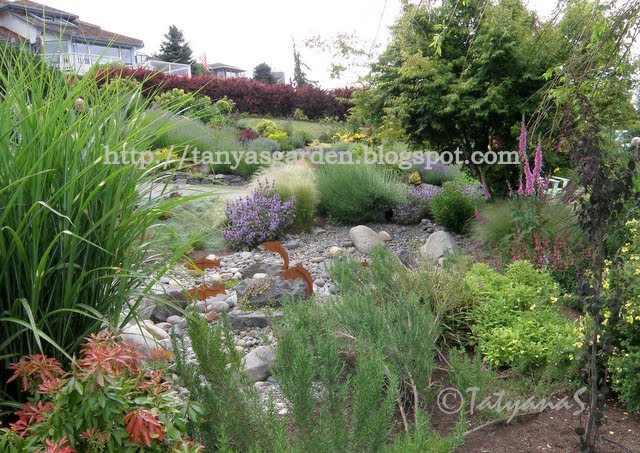
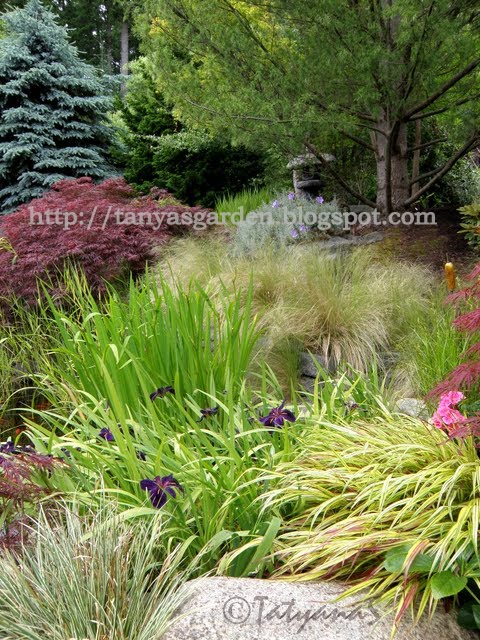
At some point, I felt like I was looking at an impressionist' painting. Lavender, pieris, euphorbia, hebe, barberry...
.

*

*
What I saw in front of the house was already enough for me to fall in love with this garden. But wait, there was much more to it!
.
*
The side and back gardens were just as impressive. Black bamboo and barberry serve as background for the Japanese garden.
*
.
Koi and goldfish ponds are another wonderful creation:
.

.
Grasses, grasses.... Oh, how much charm they can bring to a garden!
.

*

*
Always, while touring great gardens in our area, I see several plants which I want for my own garden. This time, they were
1)Hebe pimeleoides 'Quicksilver', cute little shrub with tiny silverish leaves, dark stems and small purple flowers(can grow up to 18 by 18 inches; hardiness of a zone 8). It can be seen in the 7th picture from the bottom.
2)A dark-red variety of Leptospermum (Tea Tree) with slender branches and small stiff leaves, a shrub from Australia and New Zealand.
I sincerely appreciate Terri and Ron opening their extraordinary garden which is a real inspiration full of creative ideas.
***

***Copyright 2010 TatyanaS

Views of July Garden... Plus Salmon Dinner


*
"This is more a specimen garden then the type that is usually offered by landscapers"- said my friend looking at the front flowerbed. I couldn't agree more. The company which presented its design plan to us in 2004 for this bed included several types of plants, and for each type, the number of plants were in tens and dozens. I am sure the bed would look more beautiful, more professional and more... can I use the word 'groomed'? But, what would I do, for example, with 20 Stella D'Oro daylilies? I planted 5 of them and already divided them a couple of times. Anyway, we didn't accept that plan. I started to plant what I liked, adding several plants each year. The picture above shows a side view of that bed. It changes appearance from month to month, and yes, this is a specimen garden - each type represented only by one or two plants. On the right side of the picture, there is another front bed, under two huge fir trees. The paved walk between these two beds leads to the central entrance. Logically, the two beds should include the same plants. Factually, they are different.
.

*
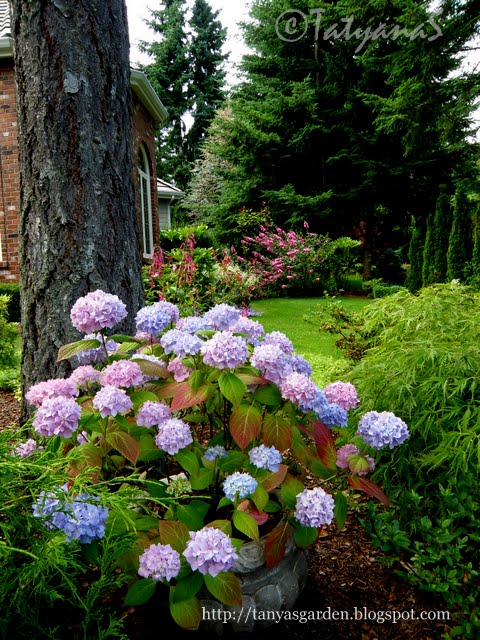
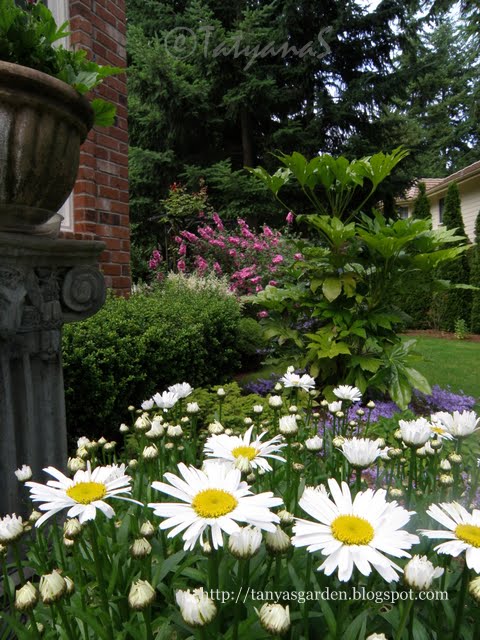
The bed under the trees, which I call The Island, is challenging for most of the plants due to a thick mat of tree roots. Thus, planting there is a constant experiment. Some plants survive, some have stagnant growth, and some don't make it. Above, there are some survivors - daisies, Japanese maple, Sungold Threadbranch cypress, hydrangea in a pot.
.

*
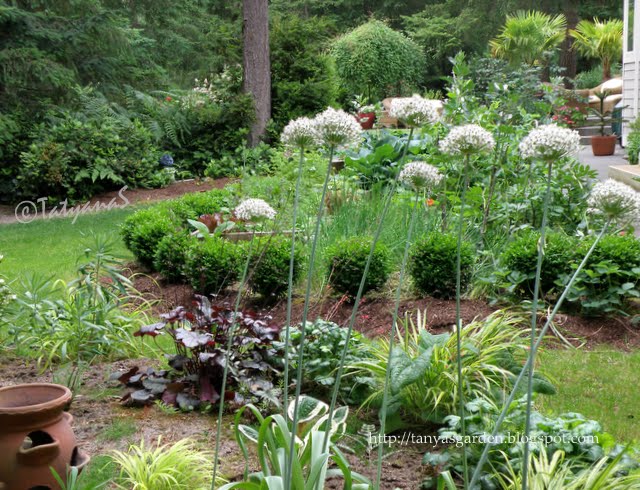
Above is the part of the backyard seen from the cul-de-sac, vegetable/perennial garden. It also changes its look every couple of weeks.
.

*
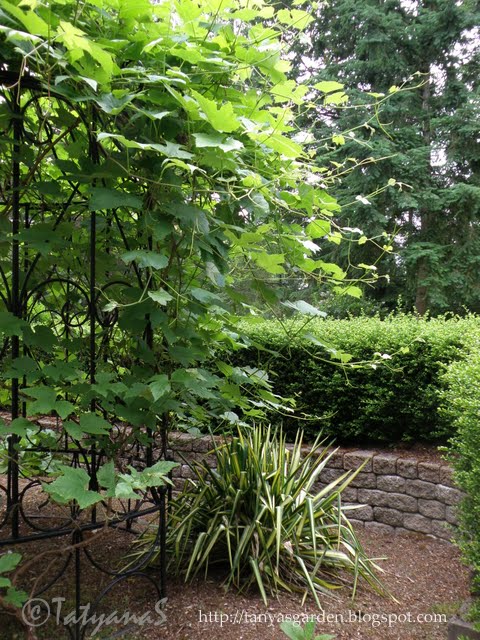
There are no complaints about this cozy corner: the grapes climbing a gazebo, ilex hedge and variegated yucca:
.

*
We used to go to the back garden through this metal arbor, but this year, it got blocked by the Tree Mallow. I think it stretches its branches toward the sun:
.

*
Another view of the right side of the front garden:
.

*
Part of the front garden with the ilex hedge, Japanese aralia, campanula and daisies, tree mallow and climbing rose in the background:
.

*
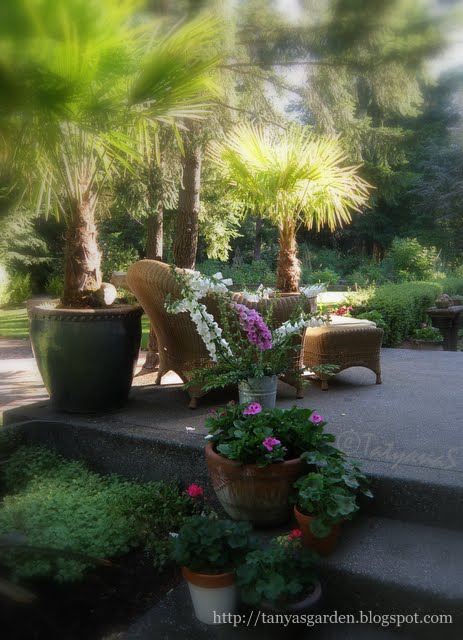
Back porch with the Terrace (vegetable/perennial) garden in the background. I hope these two palm trees will grow slow, and I won't need to replant them any time soon. To not accelerate their growth, I lightly feed them only once or twice a year with low-nitrogen fertilizer.
.

*
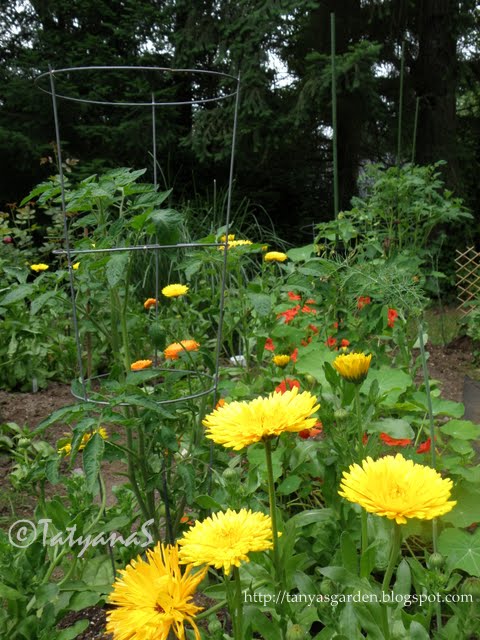
Part of the Terrace (vegetable/perennial) garden. This is where yellow and orange calendula and nasturtium clash with a deep-red Mister Lincoln rose. Calendula and nasturtium were planted as vegetable companions here, and the roses just didn't have another spot. They were given to me as a gift, and I didn't find another place for them. It's OK when the roses bloom, but it gets ugly when yellow and orange-colored blooms appear nearby. Someone needs to go...
.

*
Tomato plants look great - green and healthy, but... where are those red thingies that are supposed to hang on them? Except for the Sun Gold, there are not many tomatoes seen. A few green ones, but that's it. Typically, our tomato season starts at the end of July. Well, this summer is obviously not typical.
Below is the view of the back garden: 'Accidental' bed, kitchen garden and the back porch:
.

*
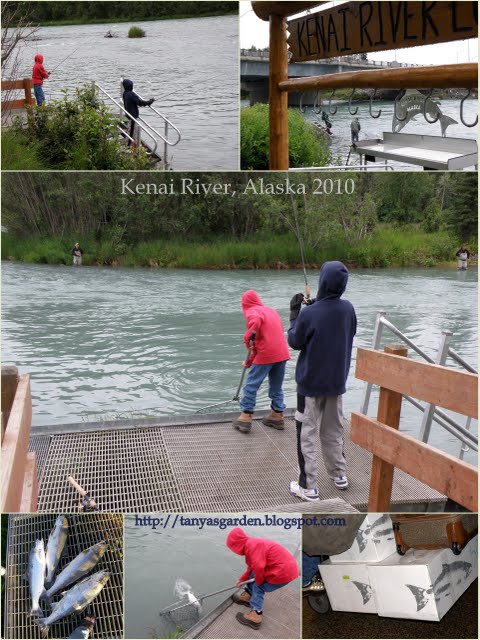
I missed one-third of July in my garden. What was the trade-off? Several beautiful, inspiring gardens in the Homer, Alaska garden tour and 125 pounds of sockeye salmon fillets.
.
.
This was the view of the Kenai River from our motel:

And this is near one of the fishing spots:
.

*
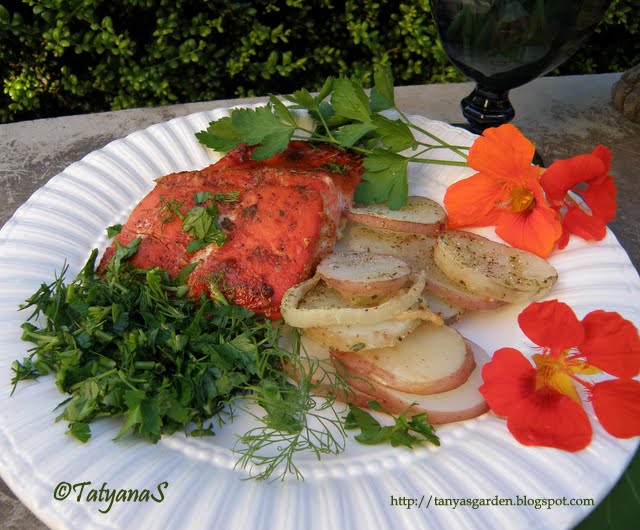
Below, is the meal where 99% of the ingredients are our own. Only the onions were bought.
.

*

Copyright 2010 TatyanaS
Blog Archive

Search This Blog

Related Posts Plugin for WordPress, Blogger...

I'M GLAD TO SEE YOU!

Labels

Abyssinian Banana (4) Actaea s. (1) Agapanthus (1) Agressive plants (1) Alaska (8) Amaryllis (5) Aquilegia (1) Aralia (4) Arizona (1) Arundel Castle Gardens (1) Autumn (47) Bainbridge Island Gardens (8) Before and After (8) Berry (4) Bird Houses (1) Bloedel Reserve (1) Blotanical (3) Blue Poppy (2) Book review (1) Botanical Gardens (3) Bouquets (9) Butchart Gardens (9) California (4) Calla (1) Canada (2) Chanticleer Garden (1) Clematis (4) Coleus (1) Colonial Gardens (7) Conifers (3) Containers (22) Corydalis (1) Dahlia (5) Dan Klennert (1) Desert Landscape (1) DIG (1) Dogs (14) Dry creek bed (1) Duris Cucumber Farm (1) Elandan Gardens (2) End of Month View (12) England (16) English Gardens (2) Euphorbia (1) Eze France Exotic garden (2) Fall garden (19) Far Reaches Farm (1) Favorite plants (52) Favorite plants. Tree Philodendron (1) Fences (2) Foliage (7) Formal gardens (1) Foxglove (14) France (4) Frankfurt Botanical Garden (1) Front Garden (5) Fuchsia (8) Garden decor (3) garden design (1) Garden elements (48) garden rooms (1) garden structure (1) Garden Tour (1) Garden works (15) Gardening Tips (4) Gardens of nature (11) Gardens to see (114) Gardens to see (tours) (25) Geraniums (2) Germany (5) GH Garden Tour (7) Giveaway (4) Giverny (2) Gossler Farms Nursery (1) Grasses (8) Great Dixter (3) Greenhouse (2) gunnera (4) Hampton Court (1) Hawaii Garden (1) Hellebores (8) Herbs and Vegetables (22) Heronswood (7) Hidcote (1) History of gardening (11) Holidays (25) Hops (1) Hosta (4) Hydrangea (7) Illumination (1) Italy (12) Japanese maple (14) Kew (4) Lakewold Gardens (22) Lavatera (1) Lavender (3) Leucosceptrum stellipilum ‘Ogon' (1) Little and Lewis Garden (1) Lobelia tupa (2) Meconopsis (2) Melianthus major (2) Minter Gardens (1) Missouri Botanical Garden (1) Mount Vernon (1) My Garden (150) My Open Garden (4) MY PICTURE OF THE DAY (80) Neighborhood (9) NPA Open Gardens (13) NWFGS (29) Old Goat Farm (3) Orchids (1) Oregon (4) PalmenGarten (2) Pampas grass (1) Peony (6) Perennials (59) Plant ID (9) Poppy (5) Problem areas (3) Recipes (2) Rhododendron (5) Rock garden (2) Romneya c. (2) Sarah P. Duke Gardens (2) Serre de la Madone (Lawrence Johnston) (1) Shade Garden (20) Shayne Chandler Garden (1) Shrubs (11) Sissinghurst (9) Sky Watch (1) Slope garden (6) Slugs (3) Spring/Summer garden (141) Stachys (1) Succulents (9) Summer/Fall garden (74) Texas Arboretum (1) The Garden of Great Depression (1) Tree Peony (2) Trees (36) Trips (81) Tulip Festival (16) Uncategorized (7) Vegetable garden (4) Vegetables (1) Villa Cimbrone (2) WA (114) Weigela (1) Wells Medina Nursery (1) White garden (3) Wild animals (21) Wild flowers (16) Windcliff (1) Wineries (1) Winter and winter garden (54) Wordless Wednesday (31) Yang's Garden and Nursery (6)
Copyright 2009-2026 TatyanaS, MySecretGarden Blog


*